
It’s called the Vendée Globe because Vendée is the region in Western France that back in 1989 got behind the idea of funding a new around-the-world yacht race that would start from Les Sables d’Olonne, a seaside town that is packed with tourists in summer but bleak and empty later in the year. The Town Fathers thought that this new race would help drive tourism to the region at a time when wind driven rain and cold temperatures are the order of the day. They had no idea just how successful it would become. Not only does the race attract over a million visitors leading up to the start, but the Vendée Globe had become one of the preeminent offshore ocean races in the world.
It’s an event that is quintessentially French despite the best efforts of the Race Organizers to attract more international entries. In the days leading up to the start the docks are packed fifteen deep with anxious fans waiting to get down onto the pontoons to see the boats up close. Old men carrying poodles, young women smoking Gauloise, small children munching on a ham and cheese baguette. All will stand patiently in the pouring rain for hours for a chance to grab an autograph from one of the skippers. They have come from all over France and are a perfect cross section of French society. There are elderly couples, young children, some obviously rich, some clearly poor, but they are all there to witness this historical event that takes place every four years.
The Machines for the job
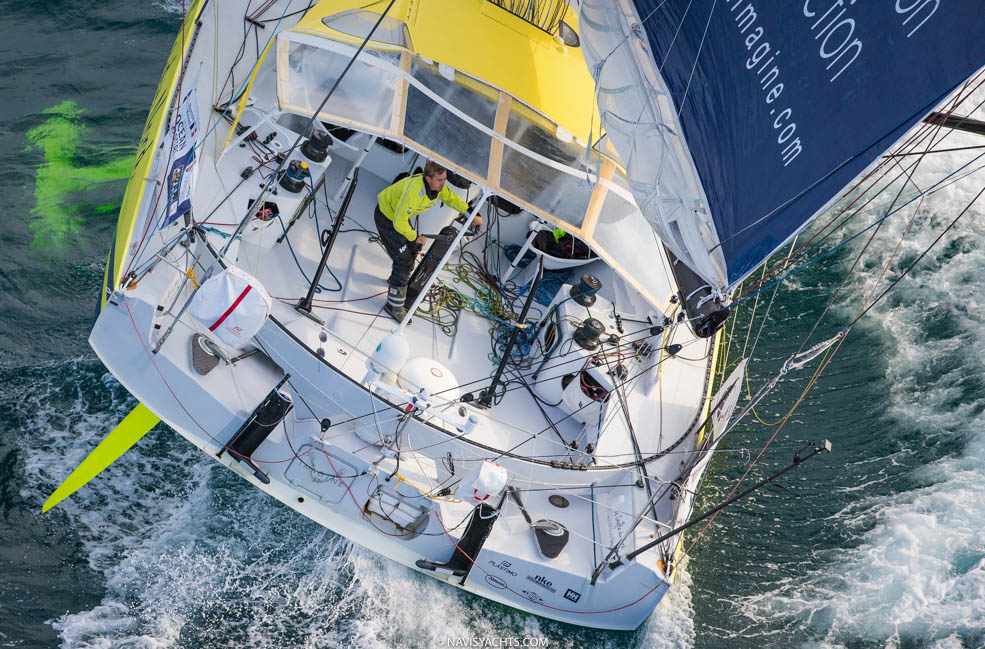
The IMOCA 60 sailboats used for the race are among the most sophisticated pieces of machinery ever devised for a single purpose. Initially when the race was conceived the rule that governed it placed very few limits on designers. There was an overall length limit of 60 feet and some stability requirements intended to keep the boats from capsizing in the big seas down south. Without restrictions, design innovations took off and have continued to evolve. The early iterations resulted in boats that were dubbed ‘aircraft carriers’ because of their extreme wide beam. The excess beam was there for getting water ballast as far outboard as possible in order to increase stability, but the outboard tanks have been traded for ballast tanks on the centerline with stability now provided by modern canting keels. Because the boats were being built so light they needed the centerline ballast tanks to give them some punch when sailing upwind.
[widgetkit id=”77″]
Jean Marie Liot, Vincent Curutchet | Words: Brian Hancock
0 Comments